Executive Summary
Enterprises need tamper-evident, independently verifiable proofs that span multiple systems and organizations. Operon.Cloud delivers consensus as a managed service: application data stays within existing systems of record, while a neutral network attests to ordering, integrity, and non-repudiation.
Design Principles
- Provider-agnostic architecture with pluggable consensus adapters.
- Minimal on-ledger footprint — anchor compact proofs, never raw data.
- Separation of duties: application APIs, secure vault, and consensus adapter each have discrete responsibilities.
- Deterministic canonicalization for consistency across jurisdictions and environments.
- Auditability and verifiability as first-class outcomes.
System Overview
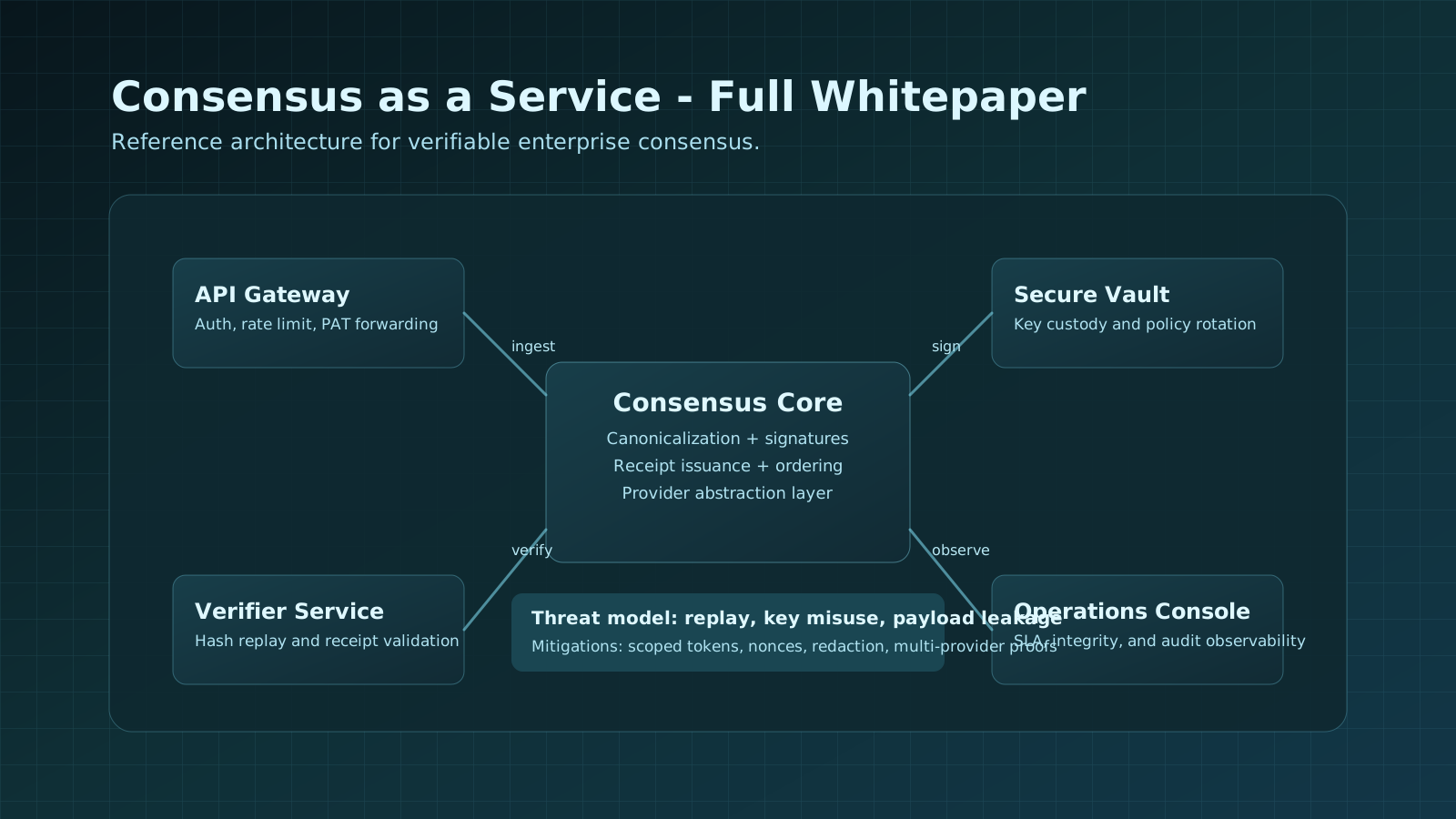
- Client Applications: Produce canonical JSON payloads and sign transactional envelopes.
- Platform APIs: Validate, enrich, and persist records; enforce rate limits and policy controls.
- Secure Vault: Manages per-topic submit/admin keys with envelope encryption.
- Consensus Adapter: Compresses proofs, handles chunking, and retrieves receipts from the network.
- Verification Tooling: Allows regulators, auditors, and partners to independently verify the anchored proofs.
Data Model & Canonicalization
Canonical Transaction JSON
Every transaction is reduced to a deterministic canonical JSON structure that includes identifiers, timestamps, payload hashes, and optional participant signatures. The canonical form deliberately excludes volatile fields to ensure stable hashing.
Canonicalization Pipeline
- Normalize field casing and whitespace for identity keys where required.
- Apply deterministic key ordering (e.g., RFC 8785 JSON Canonicalization Scheme).
- Remove volatile or non-essential fields before hashing.
- Compute payloadHash = Base64Url(SHA-256(canonical_json_bytes)).
Anchored Proof Content
- Minimal JSON containing id, workstreamId, timestamp, payloadHash, optional signatures, and nonce/counter.
- Compress (gzip/deflate) before submission to reduce bytes and chunking.
Identity, Authentication, and Authorization
- DIDs represent long-lived identities for applications, services, and organizations.
- Machine-to-machine tokens carry scoped claims (workstream_id, customer_id, workspace_id, participant_did).
- Server-side enforcement derives authorization from verified claims; the SDK is never the source of truth.
Cryptographic Constructs
- Hashing: SHA-256 for payloadHash of canonicalized data.
- Signatures: Ed25519 for envelope signatures; ECDSA (secp256k1) supported when ecosystems require it.
- Message authentication: Submit to consensus using per-topic submit keys; consensus nodes enforce signature checks.
- Envelope encryption: Vault-stored symmetric keys encrypt per-topic private keys with AES-256-GCM.
- Integrity tags: Include algorithm and version metadata; bind topic identifiers as associated data.
Secure Vault
Capabilities
- Strict access controls with least-privilege policies and continuous audit trails.
- Platform root keys protected by HSM or hardware-backed KMS, used only for data key wrapping.
- Envelope encryption for per-topic keys; ciphertext and metadata stored alongside workstream records.
- Rotation workflows with deterministic re-encryption and key versioning.
- Keys decrypted in-memory only at submission time; memory is zeroized after use.
Suggested Vault Record
{
  "algorithm": "ed25519",
  "keyVersion": 1,
  "ciphertext": "Base64(...)",
  "nonce": "Base64(...)",
  "platformKeyVersion": "v1",
  "createdAt": "2025-01-01T00:00:00Z"
}
Consensus Service Integration
Submission
- Enforce authenticated submitters with per-topic submit keys.
- Compress message bytes and maintain conservative chunk sizes (target ~6 KB if the network limit is ~8–12 KB); bound maxChunks to control costs.
- Freeze and sign transactions with the submit key; capture transaction and receipt IDs for audit.
Receipts & Finality
- Record sequence number, consensus timestamp, and running hash for every anchored proof.
- Sequence numbers may skip due to retries or multi-chunk submissions; treat them as a monotonically increasing index.
Consumption
- Consumers decompress payloads before verification.
- Recompute payloadHash against local canonical transactions.
- Verify envelope signatures (Ed25519) and resolve DID keys for each participant.
Privacy and Data Minimization
- Keep personal data out of anchored messages—hash metadata, not PII.
- Apply canonical redaction for sensitive fields or substitute deterministic hashes for correlation.
- Enable selective disclosure so validators confirm anchoring without accessing private payloads.
Replay Protection & Anti-Abuse
- Include per-message nonces or client-signed counters in anchoring envelopes.
- Scope tokens to workstreams/workspaces and enforce server-side authorization.
- Apply rate limits at API and submission layers; maintain allow lists for submit keys.
Operational Considerations
- Isolate environments for topics and keys.
- Use environment managers or vault integrations for secrets—never store them in source control.
- Adopt structured logging with PII redaction; monitor compression ratios and consensus latency.
- Implement backpressure-aware retries with idempotent semantics.
Verification Process
- Canonicalize the local transaction JSON.
- Recompute payloadHash and compare with the anchored payload.
- Resolve participant DIDs and verify signatures (Ed25519 or ECDSA).
- Validate the consensus receipt by checking the running hash or provider-specific proof.
- Confirm timestamps and sequence numbers align with expected SLAs.
Threat Model & Mitigations
Threats
- Key compromise resulting in unauthorized submissions.
- Token abuse where over-scoped credentials submit to the wrong workstreams.
- Data leakage if sensitive payloads are anchored directly.
- Replay or duplicate submissions by malicious actors.
- Consensus provider compromise affecting availability or integrity.
Mitigations
- Secure Vault with envelope encryption, strict access controls, and audit trails; leverage hardware-backed keys where available.
- Short-lived tokens scoped to workstream/workspace with enforced server-side authorization.
- Data minimization, static analysis, and canonical redaction prior to hashing.
- Nonce/counter enforcement with idempotency keys handled by Platform APIs.
- Multi-provider verifiability so receipts and running hashes remain provable even under provider stress.
Extensibility & Roadmap
- Merkle anchoring to batch proofs and reduce per-message costs.
- Multi-sig submission policies for high-sensitivity workflows.
- Automated key rotation with policy propagation and emergency revoke paths.
- Post-quantum agility through abstracted crypto interfaces.
Conclusion
Treating distributed ledger networks as consensus services — separate from business logic and primary data — provides a scalable, privacy-preserving approach to enterprise interoperability. By anchoring compact proofs, enforcing authenticated submissions, using a secure vault for key custody, and applying rigorous canonicalization and verification, organizations gain strong guarantees without vendor lock-in or data exposure.